The Electrical Parity and the Long Transition in AI Audio

Updated: Sep 2
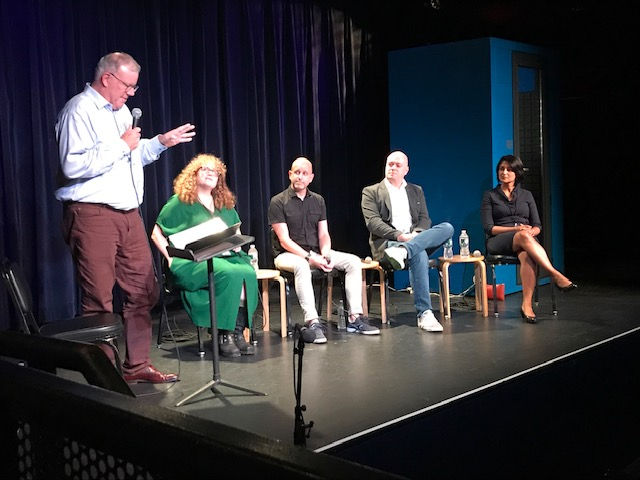
Nearly ten years ago, at the first eVOcation conference in New York City, the industry gathered to talk seriously about AI and synthetic voice for the first time. At that point, the technology still felt distant to many people working in audio. During that opening panel, one idea framed the conversation: AI would eventually shape society in ways similar to electricity.
Now, in early 2026, that prediction is finally being tested. If the pace feels slower than the headlines promised, that doesn’t mean the idea was wrong, but that a timeline is playing out exactly as it has before.
The important ‘electricity lesson’ people may be missing
Sinead Bovell and economist Ajay Agrawal recently discussed a useful historical comparison. Roughly twenty years after electricity was invented, only about three percent of companies had yet adopted it. Even more surprising, those early adopters claimed to have seen any economic benefit. From electricity!
Factories replaced steam engines with electric motors but kept the same layouts, workflows, and assumptions. The power source changed, but the system stayed the same. Productivity only accelerated once companies redesigned how work moved through the factory. This is the process of co-invention, and it is invaluable to a major invention’s success.
Real transformation does not come from plugging in a new tool. It comes from redesigning the system around it.
Where voice and AI audio are early in this process
The voiceover and production worlds are in a similar place today. Much of what is happening with AI audio involves swapping one engine for another. Synthetic voice is being used to save time or trim budgets, but the underlying structure of the work often remains unchanged, as the underlying structures of the industry are operating on certain methodologies.
This shows up in familiar ways. AI is added to existing pipelines. Automation is treated as a shortcut. New tools are expected to deliver results without rethinking how audio is created, approved, or distributed. That approach limits the impact.
We're headed into a period where real change begins
True transformation starts when the work itself is redesigned. In audio, the catalyst for that shift is hyper personalization. The industry is moving toward mass one to one communication, where a single campaign can generate hundreds of variations in real time. Dynamic Creative Optimization is no longer theoretical. It is becoming standard practice across political, commercial, and global campaigns.
Industry Adtech research indicates that brands using listener data for personalized audio messaging see stronger engagement when targeting context and preferences. That growth cannot be supported by traditional production models alone. It requires new infrastructure, new workflows, and a different relationship between human judgment and machine efficiency.
What co-invention looks like in practice
This shift is not about finding a cheaper way to record. It is about building systems that can handle volume without losing nuance. Human performance still carries emotional accuracy, cultural understanding, and timing that technology cannot reliably reproduce on its own.
The work now is designing environments where AI supports scale and speed, while people remain responsible for tone, meaning, and intent. That balance is where audio continues to work, even as expectations change.
Why patience matters more than speed
AI has been compared to electricity for years, but electricity didn’t simply transform society overnight. The organizations that benefited most were not waiting for a breakthrough moment. They were redesigning how work flowed through their businesses long before the gains became obvious.
The same pattern is emerging in audio. Long-term leaders won't be the ones who adopt tools the fastest. They will be the ones who rethink how sound is created, personalized, and delivered, without losing the human qualities that make it effective.
What we're seeing a total rewire of industries, not a sprint toward short-term goals
What is unfolding now is not a quick revolution. It is a structural rewiring of how audio fits into communication, marketing, and storytelling. AI plays a critical role, but its real impact comes from co-invention rather than automation alone. The future of sound belongs to teams willing to redesign the system instead of simply plugging into it.
Links & References
AdsWizz. (2023). State of audio adtech report 2025 (personalization & targeting insights). Retrieved from https://insights.adswizz.com/hubfs/The%20State%20of%20Audio%20Adtech%20Report%202025/The%20State%20of%20Audio%20Adtech%20Report%202025.pdf
Bovell, S. (2025, October 2). Is artificial intelligence overhyped? An economist’s take on what we’re actually missing. Substack. https://sineadbovell.substack.com/p/is-artificial-intelligence-overhyped